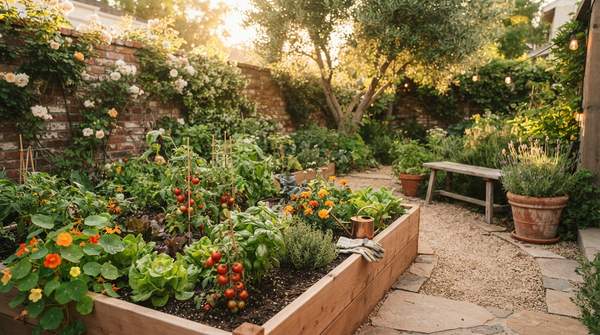
A productive small garden starts as a sequence of decisions, not a pile of tips: assess what your yard offers, pick a layout style that fits it, place one element that draws the eye, and then use two planting techniques—interplanting and succession planting—to pull more food from the same footprint. Sources across nursery advice, the Old Farmer's Almanac, and small-space design guidance converge on this order of operations. This guide walks through each decision and ends with a framework you can fill in for your own yard.
Step 3: Choose Your Primary Layout Style
Once you know your space, sunlight, and fixed features, the central structural choice is how to plant: in the ground, in containers, or in raised beds. For small yards, raised beds and square-foot gardening are the layouts most often recommended, because they concentrate fertile soil in a defined footprint and keep the organization visible.
A square-foot approach divides a raised bed into one-foot sections, with the number of plants per square set by crop size. The Almanac's square-foot garden plan, credited to executive digital editor and Indiana master gardener Catherine Boeckmann, offers a concrete example: a 7 × 4-foot bed—28 one-foot squares—rated as beginner difficulty, planted spring through fall in rich, well-drained raised-bed soil with regular moisture. Note the sun requirement attached to that specific plan: full sun, meaning at least six hours of direct sun daily. If your yard gets less, that particular plan needs a sunnier spot or different crops, not just tighter spacing.
Raised beds also have practical, tactile advantages. Writing in Grit, veteran gardeners describe them as neat, clean, and easy to handle: you can walk all the way around them, thin plants without getting dirty, and arrange as many beds as you like in whatever configuration suits the yard.
Step 4: Integrate Aesthetic Focal Points
Yield is not the only measure of a small garden's success. Design guidance for small spaces emphasizes that a garden is something you experience at ground level, not just a diagram viewed from above. Gardeners naturally take measurements and graph out walkways and beds, but the joegardener podcast's small-space design episode, drawing on designer Susan's advice, recommends stepping down from that bird's-eye view to imagine the experience you will actually have with each element.
Her suggested method is hands-on: make cardboard cutouts matching the dimensions of items like chairs or fountains, place them where you envision them, and test the result. Can you navigate around them easily? Do they block the view of a focal point or the scene from your window? A cutout of a bench or birdbath costs nothing to move; the real object does not. This exercise helps you anticipate problems before committing a structure to the ground, and it keeps one visual anchor—a focal point—as an organizing element of the layout rather than an afterthought.
Beauty and productivity can also share the same square footage. The Grit article notes that flowers and herbs contribute fragrance and color, and that veteran gardeners find herbs and some flowers have a beneficial effect on garden health, including edible flowers such as nasturtiums.
Boost Your Yield: Interplanting for Efficiency
With the layout chosen, two planting techniques turn it into a higher-yielding one. The first is interplanting: pairing fast-growing crops with slow-growing ones in the same bed. Shoal Creek Nursery's planning guide gives the classic example—radishes sown between carrots. Radishes are ready to harvest in weeks, well before the slower carrots need the room, so the same patch of soil produces two harvests instead of one. In a small layout, this means every square foot works twice: sketch fast crops like radishes or leaf lettuce into the rows and squares occupied by slower vegetables, and harvest the quick crop before the main one fills in. The nursery guide frames interplanting as a way to maximize space while keeping the harvest coming.
Interplanting also supports the organization principle the same guide recommends: group plants with similar water, sunlight, and nutrient needs together, which simplifies watering and fertilizing. Choosing interplanted pairs with compatible needs keeps that benefit intact.
Boost Your Yield: Succession Planting for Continuous Harvest
The second technique is succession planting: staggering sowing dates instead of planting an entire crop at once. Shoal Creek Nursery's example is lettuce sown in a new batch every two weeks, so one bed yields a steady supply through the season rather than a single glut followed by nothing. In practice, this means your layout plan should not assign every square to a one-time planting. Reserve part of a bed or a few squares for repeating sowings, and mark the intervals—every two weeks in the lettuce example—on the same sketch that holds your layout. Succession planting maintains yield over time rather than expanding yield per harvest, which is exactly the constraint a small yard faces: there is no room to plant more, so the calendar becomes the extra acreage.
Shoal Creek Nursery's guide summarizes the combined approach plainly: by assessing your space, planning your layout, and incorporating strategies like interplanting and succession planting, gardeners set themselves up for a productive season.
Your Small Garden Layout Decision Framework
Use this matrix to move from a blank yard to a concrete layout concept that balances productivity and visual appeal. Work top to bottom: each row answers one planning decision, and the final column shows what that choice does for a small space.
| Planning decision | Key consideration | Evidence-based option | Impact on a small garden |
|---|---|---|---|
| Layout style | Space optimization | Raised beds or square-foot gardening (e.g., a 7 × 4-foot, 28-square bed; full sun means at least 6 direct hours daily) | Concentrates growing space in a defined, organized footprint and maximizes yield in limited area |
| Aesthetic integration | Visual appeal and experience | Place one focal point (birdbath, fountain, bench); test placements with cardboard cutouts at true dimensions | Creates a visual anchor and reveals navigation or view problems before anything is built |
| Yield technique one | Space efficiency | Interplant fast crops (radishes) between slow ones (carrots) | Two harvests from one patch; squares work twice per season |
| Yield technique two | Harvest continuity | Succession planting: sow a new lettuce batch every two weeks | Steady supply instead of a single glut—time replaces the space you lack |
Fill in each row with your own yard's measurements and crop choices, and the completed matrix is your layout concept: a bed size, a focal point location, and a planting calendar.
Your Productive and Beautiful Small Garden Awaits
The decision is to implement your custom garden layout plan, incorporating both the aesthetic design principles and the yield-maximization techniques above. The measure of success is concrete: a visible increase in harvest quantity from interplanting and succession plantings, and a cohesive, visually appealing garden space that aligns with your initial design sketch. Before the first sowing, check one number against your yard—the six-hour direct-sun threshold for a square-foot raised bed—and you will know whether the plan you sketched is the plan that will feed you.
Sources
- Planning Your Garden Layout: Maximizing Space and Yield — Shoal Creek Nursery
- Small Vegetable Garden Plans and Layouts — Almanac.com
- Small Space Garden Design Tips | Less is More — joegardener® | Organic Gardening Like a Pro
- Square-Foot Garden Plan: 7×4 Layout — Almanac.com
- Garden Plan Layouts For a Small Backyard - Grit — Grit - Rural American Know-How