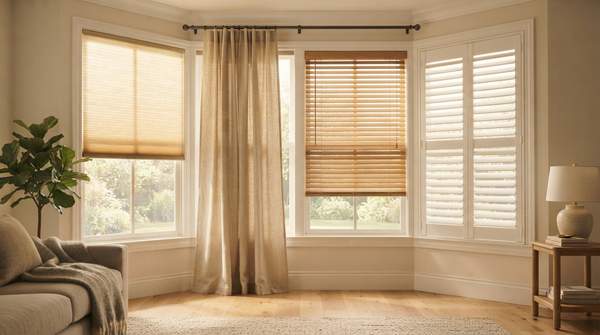
There is no single "best" window treatment—there is only the best one for what you need most. If your top priority is insulation, cellular (honeycomb) shades are widely considered the most energy-efficient option because their cells trap still air against the window. If you want precise, adjustable control over both light and privacy, shutters lead the field. Curtains and drapes deliver strong thermal performance when chosen and hung thoughtfully, while blinds offer simple, affordable light steering with more modest insulation. Here is how the four compare, and how to match them to each room.
Cellular Shades: Balancing Efficiency and Flexibility
Cellular shades earn their insulation reputation through physics rather than marketing. As Stacy Rose explains in a winter-comfort guide, effective window treatments work by "creating an insulating air layer"—air that is trapped and kept still acts as a natural insulator—and by reducing drafts around the window opening. Honeycomb shades are built around exactly this principle: their signature structure traps air within individual cells, forming a barrier between the glass and the room. Double- and triple-cell designs add further resistance to heat flow, helping keep indoor temperatures more consistent in colder months.
The same design serves privacy and daylight well. Light-filtering fabrics let daylight in while keeping interiors comfortable and private, and blackout fabric options create darkness for sleeping. Retailer guidance notes these shades are especially effective in bedrooms and family spaces where comfort matters year-round, and side-channel tracks that stop air leaking along the edges maximize their efficiency.
Curtains and Drapes: Versatility and Thermal Benefits
Curtains can look like ordinary window treatments, but thermal linings change their performance entirely. Energy-focused guidance recommends drapes that mount outside the window frame, run floor to ceiling, and hug the walls on both sides; thicker fabrics and wool blends increase effectiveness, and blackout drapes with a white lining facing the window reflect sunlight to help keep rooms cooler in summer. In other words, insulation here is conditional—it depends on fabric choice, thickness, and fit.
Layering multiplies the benefit. An insulating shade mounted close to the glass acts as the primary barrier while heavier drapery over the window blocks drafts along the frame. On light control, curtains are more binary: sheer fabrics filter light gently, blackout drapes block it completely, but the adjustment is essentially open or closed rather than fine-tuned. Fully closed opaque drapes do provide complete privacy, which is why blackout curtains are a standard bedroom recommendation.
Blinds: Adjustable Control with Practicality
Blinds are the straightforward option that still gets the job done. With adjustable slats, you can angle light upward while blocking sightlines from outside—an approach that continues to work well, and wood or faux-wood blinds hold up over time. That tilt mechanism is their core strength: you can redirect glare, admit partial light, or close up entirely, all in seconds.
The trade-offs sit in the gaps. Because slats are separate pieces, heat can transfer between them, making blinds less effective at insulation than cellular shades or thermal drapes. Privacy is likewise less consistent than with solid or cellular options—closed slats still leave small sightlines at certain angles. Blinds make the most sense where light steering matters more than thermal performance or total seclusion.
Shutters: Durable Privacy and Precise Light Management
Plantation shutters offer the most granular control of the four. Their adjustable louvers let you fine-tune the balance between privacy and light throughout the day: tilt them open to filter sunlight while blocking direct outside views, or close them completely when privacy matters most. Because they can mount inside the window frame, they present a solid, built-in appearance.
Shutter specialists describe their privacy control as high and fully adjustable, with precise light modulation—tilt slats to your liking—compared with the more limited, all-or-nothing adjustment of fabric treatments. They also contribute to energy efficiency: shutters act as an additional barrier against outdoor temperatures, helping keep interiors cooler in warm months by minimizing direct sunlight and retaining warmth in cooler seasons.
Comparative Performance of Window Treatment Types
The table below contrasts the four types across the three criteria so you can match the strongest performer to your highest-priority need. Where evidence shows performance is conditional, the qualification is stated rather than smoothed over.
| Window Treatment Type | Insulation / Energy Efficiency | Light Control | Privacy |
|---|---|---|---|
| Cellular Shades | Strongest of the four; cells trap still air as an insulating barrier, and double- or triple-cell designs increase resistance to heat flow. Side tracks reduce air leakage. | Flexible: light-filtering fabrics admit daylight; blackout fabrics create darkness. | Good, especially with light-filtering or blackout fabrics; well suited to bedrooms and family spaces. |
| Curtains/Drapes | Effective when thermal-lined, thick (wool blends help), floor-to-ceiling, and wall-hugging; layering over an insulating shade adds warmth. | Limited to mostly open or closed; sheers filter, blackout drapes block fully. | Complete when fully closed with opaque or blackout fabrics. |
| Blinds | Less effective than cellular shades or thermal drapes; gaps between slats allow heat transfer. | Adjustable—tilt slats to angle light and cut glare; wood and faux wood hold up well. | Less consistent; slat gaps can leave sightlines even when closed. |
| Shutters | Acts as an additional barrier against outdoor temperatures, retaining warmth in cool seasons and limiting sun in warm ones. | Precise—tilt louvers to diffuse harsh rays or invite soft light. | High and fully adjustable; close completely for maximum seclusion. |
Read the table by priority, not by overall winner. If energy efficiency tops your list, cellular shades stand out; if precise, secure control of light and privacy is the goal, shutters lead; if you want complete privacy on demand with a simple open/closed choice, blackout drapes deliver; if you mainly need to steer daylight, blinds are the practical pick.
Choosing the Right Treatment for Each Room
Room conditions should refine your choice. Bedrooms typically benefit from options that block outside visibility while reducing incoming light—blackout curtains, cellular shades, and layered combinations of blinds with drapery all work well, and layering lets you adjust natural light throughout the day. Cellular shades in light-filtering fabric suit family spaces where you want daylight and privacy at once.
Think about how each room is used before committing: a room where darkness matters points to blackout-capable cellular shades or drapes; a room where you want daylight without exposure points to shutters or light-filtering shades; a room where you simply redirect glare points to blinds. The proximity of neighbors or busy streets should also raise the weight you give privacy in that particular window.
Making Your Informed Window Treatment Decision
Homeowners should prioritize their most critical need—insulation, light control, or privacy—and then select the window treatment type that offers the strongest performance in that area, considering room-specific conditions like the need for darkness or natural light. Cellular shades for efficiency, shutters for precise control, thermal drapes for closed-door privacy, and blinds for adjustable daylight.
The measurable indicator of a good choice is visible after installation: window treatments that noticeably improve room comfort, reduce drafts, stabilize temperatures, or deliver the light and privacy levels you wanted. If, after a season, the room still feels drafty or too exposed, that is your signal to revisit the priority—perhaps layering a second treatment—rather than accepting the compromise.
Sources
- Best Window Coverings for Energy Efficiency — Constellation Residential and Small Business Blog
- How Window Treatments Help Homes Stay Warmer in Winter — Local Magazine Publications | Best Version Media
- \r\n \n How to Choose the Perfect Window Treatments for Every Room\n \r\n — Americanblindwholesaleoutlet
- Top 5 Window Treatments for Privacy with Blinds and Shades — Strickland's Home
- The Psychology of Privacy — Riverwood Blinds Shades N Shutters
- Best Window Treatments for Privacy Without Losing Light - Louver Shop Shutters
- Benefits of Window Shutters for Privacy and Light Control — White's Draperies and More