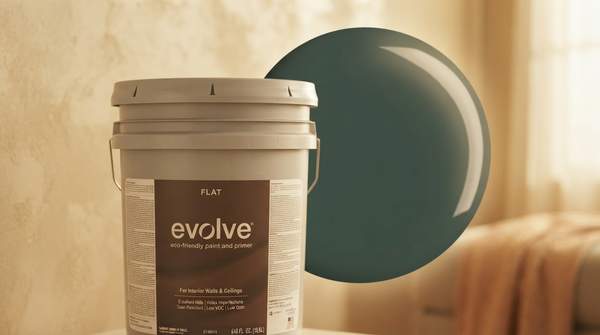
If you want a healthy, sustainable finish for your walls, the single most useful thing you can do is stop treating "zero-VOC" as the whole decision. A paint base can qualify as zero-VOC and still pick up volatile organic compounds at the tinting counter, and a cheap gallon that needs extra coats can cost more per project than a premium one. Here is a four-part framework—emissions, certifications, durability, and true cost—that lets you evaluate any brand on the shelf, plus a look at how several named paints stack up.
Beyond "Zero-VOC": What Eco-Friendly Paint Really Means
VOCs are volatile organic compounds—chemicals that evaporate into the air as paint dries and cures. They're responsible for much of that "fresh paint smell," and as Clare's own paint guide explains, the smell isn't the only concern. That's why the label matters, but also why it isn't the end of the story.
The catch is what Clare calls the "colorant loophole." A paint base may technically qualify as zero-VOC, but once colorants are added at the paint counter, those tints can introduce additional VOCs. So a paint marketed as "zero-VOC" isn't always as zero as it seems. This applies specifically to paints where colorants are added separately and aren't themselves zero-VOC—which is most conventional tinting systems.
The practical takeaway: ask whether the tinted, shelf-ready product—not just the base—has been tested for emissions. ECOS Paints, which makes its own products, also cautions against "zero-VOC tunnel vision": not all VOCs are equally harmful, and VOC data should be treated as one signal, not the whole decision. Ask what else is in the formula, including preservatives, additives, and pigments.
Key Criteria for Choosing Eco-Friendly Interior Paint
Once you understand the label's limits, evaluate any candidate paint against four criteria:
- Emissions, tested not claimed. Look for the VOC number in grams per liter, and confirm it applies to the tinted product. Where colorants are added separately, check for low-VOC colorants or a certification that tests the finished product.
- Third-party certification. GREENGUARD Gold is the benchmark most often cited for rigorous indoor-air-quality standards. ECOS Paints' buying guide also recommends confirming the test category behind any certification and checking that the brand's claims are consistent across its whole range, not just one "green" product.
- Durability matched to the room. ECOS suggests matching sheen and finish to room traffic and seeking cleanability guidance. This Old House's paint guide adds that a quality latex paint with a high percentage of pigment and binder solids—particularly 100 percent acrylic polymer binders—can extend durability, while eco-minded buyers may also want natural pigments and low biocide content.
- True cost, not sticker price. ECOS frames it as cost per year, not just per gallon: estimate the number of coats plus your repaint cycle. Coverage per gallon drives how many cans you actually buy.
Transparency underpins all four. When a brand is vague about ingredients, you can't properly evaluate risk, odor, or indoor-air impact—so a brand that answers questions plainly, in its tech sheets and safety documents, gives you something to compare.
Your Eco-Friendly Paint Decision Framework
Here's how the criteria come together. The matrix below applies the four dimensions to specific interior paints, using the comparison data published by FacadeColorizer for 2026 alongside brand-reported figures. FacadeColorizer's scrub-cycle and price figures are its own compiled comparison, not manufacturer lab reports, so treat them as indicative rather than certified.
| Paint | VOC Status | Certifications | Scrub Resistance (ASTM D2486) | Price per Gallon (2026) |
|---|---|---|---|---|
| Sherwin-Williams Harmony | < 5 g/L | GREENGUARD Gold, MPI X-Green, anti-microbial | 600+ cycles | $73–$85 |
| Benjamin Moore Natura | 0 g/L | GREENGUARD Gold, Asthma & Allergy Friendly | 500+ cycles | $69–$78 |
| Behr Premium Plus Ultra | < 5 g/L | GREENGUARD Gold, Green Seal GS-11 | 450+ cycles | $42–$48 |
| Clare Paint | Zero-VOC | GREENGUARD Gold | 350+ cycles | $56–$64 |
| Backdrop | < 5 g/L | GREENGUARD Gold, MPI X-Green | 400+ cycles | $58–$66 |
| ECOS Paints Atmosphere Pro | Zero-VOC, no biocides | GREENGUARD Gold, Declare Red List Free | 300+ cycles | $72–$95 |
| AFM Safecoat | < 10 g/L | CDPH v1.2, MAS Certified Green | 350+ cycles | $65–$80 |
| Farrow & Ball Estate Emulsion | < 1 g/L | EU Ecolabel, Class A+ emissions | 250+ cycles (matte) | $120–$135 |
How to read it: a high-scrub paint like Harmony suits high-traffic areas and sensitive spaces such as nurseries, per FacadeColorizer's recommended-use column, while a lower-scrub matte like Farrow & Ball's Estate Emulsion is better suited to low-traffic rooms. For chemical sensitivity, ECOS's Atmosphere Pro line pairs zero-VOC status with no biocides and Declare Red List Free certification—ECOS describes its own paints as water-based, latex-free, and zero-VOC, developed over 35 years specifically to avoid chemicals that could cause health issues.
On cost, Green Builder Media's roundup reports Clare at roughly $59 per gallon covering about 375–425 square feet per gallon, and Harmony at around $75.49 per gallon. FacadeColorizer separately lists ECOS Paint as covering about 560 square feet per gallon—often more than traditional options—meaning fewer gallons for the same project. That's the true-cost calculation in action: divide price per gallon by coverage, then multiply by coats needed.
Applying the Framework: What the Examples Show
Notice what the comparison reveals. Every paint in the table carries GREENGUARD Gold or an equivalent third-party certification, which suggests certification alone no longer differentiates premium eco-paints. The real trade-offs are elsewhere: Behr's Premium Plus Ultra offers the lowest price with mid-pack scrub resistance, while the zero-VOC options (Natura, Clare, ECOS) tend to cost more per gallon—Clare's own guide acknowledges zero-VOC paints may cost slightly more than some low-VOC options, with many homeowners judging the healthier indoor air worth it.
Durability claims deserve the same skepticism as VOC labels. FacadeColorizer's scrub-cycle figures are compiled comparisons, and the evidence here doesn't include manufacturer-published ASTM D2486 test reports for these specific lines—so ask for the technical data sheet before paying a premium for "600+ cycles." ECOS's advice applies: review customer testimonials to gauge real-world performance, and prioritize brands that make their own products with a multi-year development story.
Making Your Final Eco-Friendly Paint Choice
Choose an eco-friendly interior paint by prioritizing third-party certifications like GREENGUARD Gold, understanding the true VOC content including colorants, and evaluating durability claims against your specific room's needs and long-term cost. The relative weight of each factor depends on your priorities: a nursery or an allergy-sensitive household justifies different choices than a rarely-used guest room.
Before you buy, check two things: the chosen paint's technical data sheet confirms GREENGUARD Gold certification for the tinted product, and the estimated cost per square foot—price per gallon divided by coverage, times coats needed—aligns with your project budget and expected lifespan. If both check out, you've moved well past the marketing label to a genuinely healthy, durable choice.
Sources
- Zero VOC Paint vs Low VOC Paint: What's the Actual Difference? — Clare
- Ecospaints: ECOS Paints, which makes
- A Guide to Eco-Friendly Paints — This Old House
- Best Low-VOC Paint 2026: 8 Baby-Safe Brands Compared — FacadeColorizer
- Ecospaints: ECOS describes its own paints
- A Deep Dive Into Non-Toxic Paints and VOCs — Greenbuildermedia